

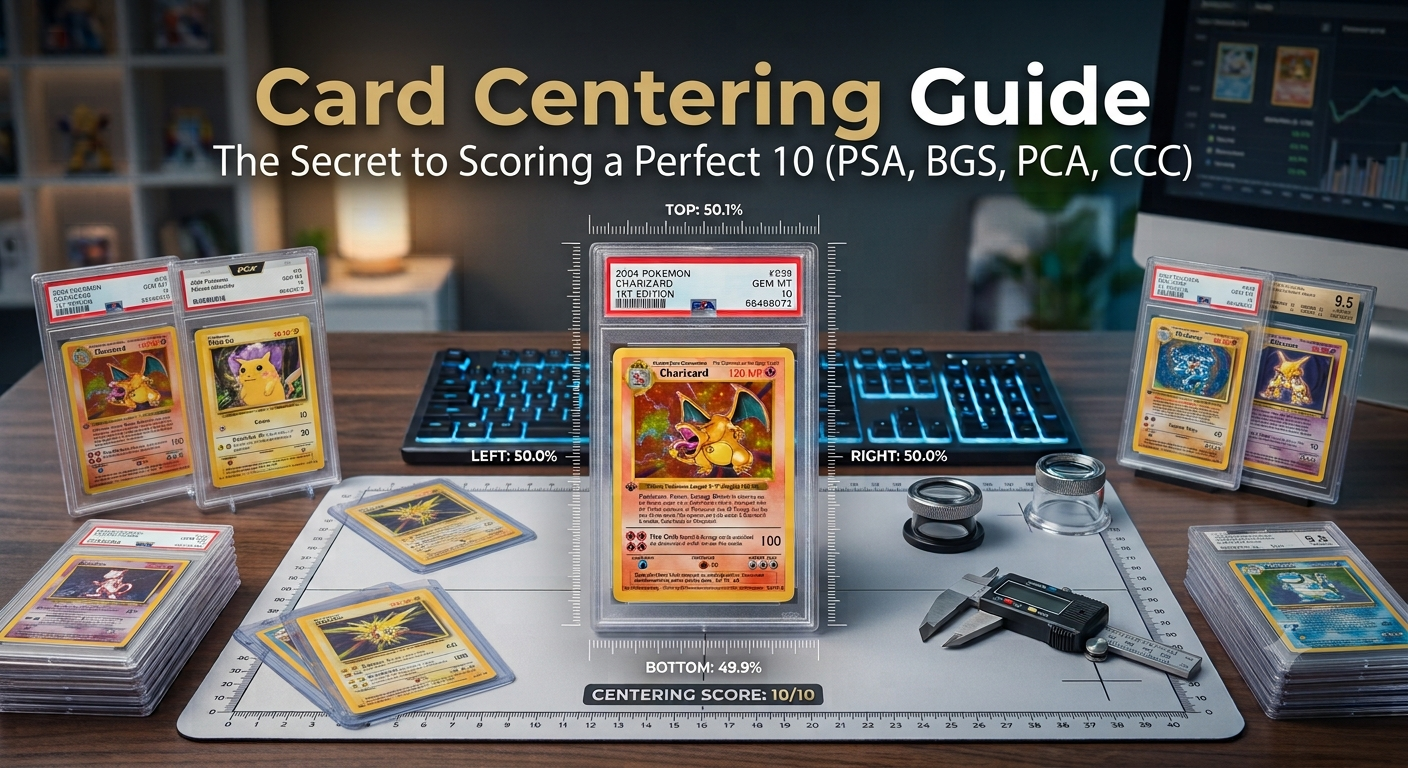
In the trading card grading ecosystem (Pokémon, Magic: The Gathering, One Piece), centering occupies a unique position. Unlike corners or surfaces that degrade over time, centering is an intrinsic defect, determined at the factory during printing and cutting. Even a card pulled fresh from a sealed booster pack can display major off-centering, making it the primary limiting factor for achieving a perfect grade.
1. The Anatomy of Centering: Measurements and Calculations
Centering measures the symmetry of the artwork relative to the card's outer borders across two axes: horizontal (left/right) and vertical (top/bottom). For an accurate assessment, experts use a percentage ratio.
The Scientific Formula
To achieve a professional result, use this formula (measured in millimeters or pixels):
$$\text{Border A Percentage (%)} = \left( \frac{\text{Border A Width}}{\text{Border A Width} + \text{Border B Width}} \right) \times 100$$
Note: The final centering grade is systematically capped by the worst-performing axis. If your card features a perfect 50/50 horizontal ratio but drops to 65/35 vertically, its official centering ratio will be recorded as 65/35.
2. TCG Specifics: The Optical Impact
Centering is perceived differently from one game to another because border colors act as visual amplifiers.
- Pokémon / One Piece: Centering is measured on yellow, gray, or black borders. Misalignments become apparent incredibly fast on the thin borders of Japanese cards.
- Magic: The Gathering (MTG): The ultra-thin black borders make even the slightest shift glaringly obvious against the lighter background of the artwork.
- Full-Art Cards: Without clearly defined borders, experts measure the distance between the physical edge of the card and fixed text elements, such as the text box frame or the character's name.
3. Standard Breakdown: PSA vs. BGS vs. Europe
PSA: Shifting Toward Strictness
Long considered highly lenient with its historical tolerance of 60/40 on the front for a PSA 10 Gem Mint, PSA has tightened its criteria considerably. The stakes show in the prices: on the most expensive PSA 10 Pokémon cards, the grade multiplies the value of the raw copy.
- PSA 10: Now strictly requires roughly 55/45 on the front (75/25 on the back).
- PSA 9: Accepts a wider ratio from 60/40 to 65/35.
BGS (Beckett): Chasing the Holy Grail
Beckett remains the undisputed master of subgrades (detailed individual scores displayed on the label).
- BGS Black Label 10: Demands a flawless 50/50 ratio across all four criteria.
- BGS Pristine 10: Tolerates minor variations between 50/50 and 55/45.
- BGS Gem Mint 9.5: Permits up to a 60/40 alignment.
European Standards (PCA, CCC, GSG)
- PCA Grade (France): Although their official charter mentions 60/40, internal practices are much stricter. A PCA 10 requires around 54/46, while the elusive PCA 10+ Collector demands a near-perfect 51/49 symmetry.
- CCC Grading (France): Utilises an algorithm indexed against the lowest sub-score. If the centering is disastrous (under 8/10), CCC may append an Off-Centered (OC) qualifier to the slab to avoid penalizing an otherwise pristine card.
- GSG (Germany): Renowned for its clinical precision, their Black Label 10.0 enforces a strict 50/50 balance, verified via digital forensic microscopes.
4. Home Auditing: Expert Tips
Before investing in grading fees, audit your collection at home without putting your cards at risk.
- The Caliper Test (CONTACTLESS): Never place the metal jaws of a digital caliper directly onto a raw card; the risk of scratching the surface is far too high. Instead, take a flat, high-resolution photo, display it on a large screen (tablet or PC), and take your measurements directly off the monitor.
- Artificial Intelligence: Mobile apps and web platforms like CardGrade.io or CenterGrade use advanced algorithms to calculate your border ratios down to the exact pixel in seconds from a simple picture.
Conclusion: Center Your Cards to Maximize Value
Centering is frequently the ultimate gatekeeper separating a €200 card from a €1,000 card. By mastering the tolerances of each company, you can make a strategic choice: aim for BGS or CCC if your card is dead-centered at 50/50, and pivot to PSA if your copy leans closer to 55/45 or 60/40.
🔗 Read also: Card Grading in 2026: The Ultimate Guide to Choosing Your Grading Company